Multiscale Mechanics for Alloys
Alloys are among the most important engineering materials. For structural applications, we usually need both high strength and good ductility. In real components, additional requirements also matter, such as fatigue resistance, corrosion resistance, and high-temperature performance.
During my PhD, I studied precipitation strengthening mechanisms in Al-6xxx alloys. The outcome is a validated multiscale model that can be used to guide precipitate-strengthened alloy design.
Highlights of this work include:
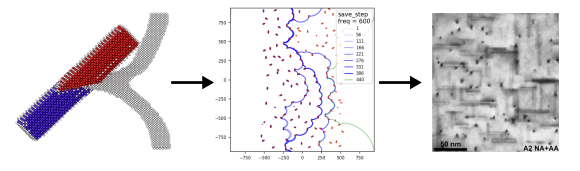
- A complete multiscale workflow — from DFT (atomistic database), to molecular simulations (neural-network potential), to discrete dislocation dynamics (mesoscale simulations)
- Atomistically informed mesoscale simulation by incorporating key atomistic mechanisms into discrete dislocation dynamics
- Use of state-of-the-art neural-network potentials for realistic strengthening analysis
- A strength-prediction model that helps identify optimized microstructures
more about my PhD
Topology Optimization
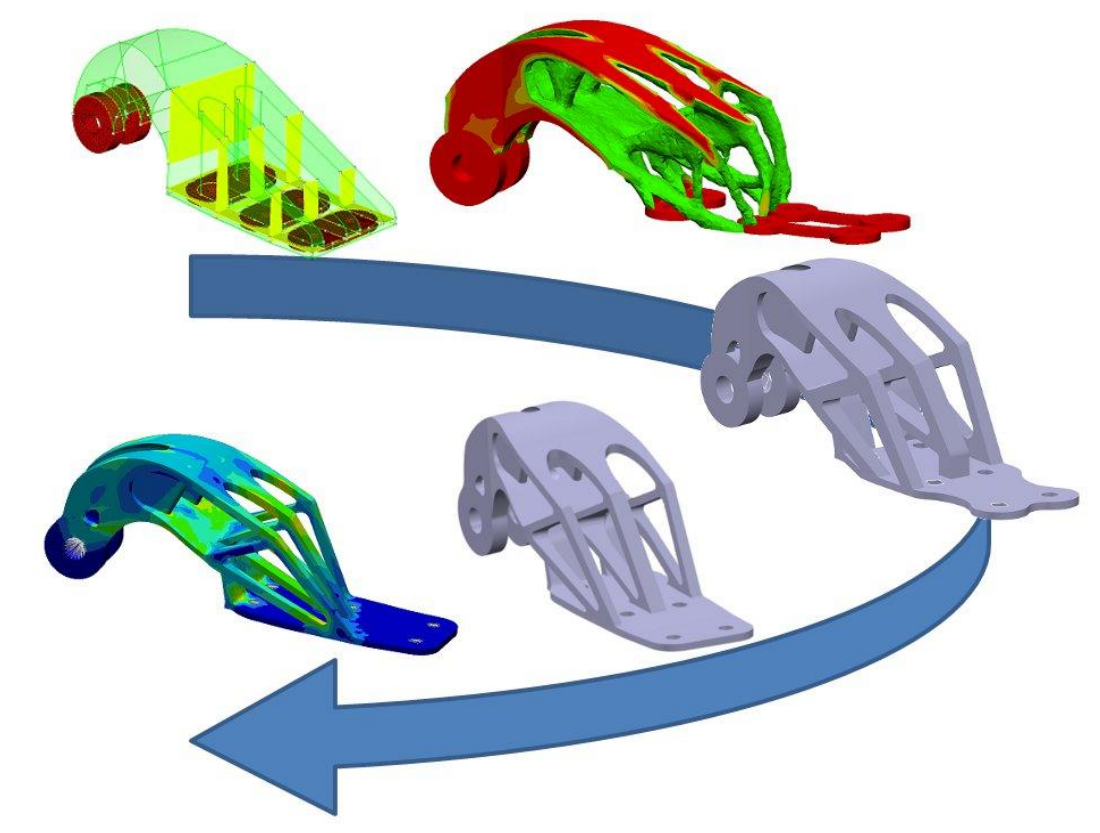
Designing mechanical components often requires a large amount of engineering experience and trial-and-error. Engineers usually decompose a design into subproblems and solve each part using known methods and intuition. Topology optimization allows algorithms to search for a best-possible design under explicit constraints.
As in a standard mathematical optimization problem, we define:
- an objective function to minimize,
- constraints that represent design limits,
- governing physical laws (for example, mechanical equilibrium for static problems).
In practice, the following issues are especially important:
- robust objective and constraint definitions for both solvability and engineering meaning,
- efficient solution with PDE/ODE constraints,
- mitigation of common numerical issues (checkerboarding, mesh dependency, local minima).
phase-field approach and implementation
Damage Simulation in Civil Engineering
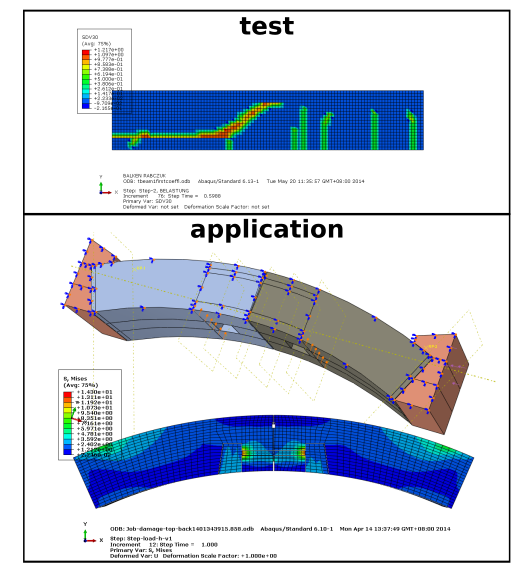
During my undergraduate study, I worked on damage simulations for civil-engineering structures, especially reinforced concrete. Understanding damage and fracture behavior in these structures is essential for practical design and assessment.
In my bachelor thesis, I used user-defined elements/materials (UEL/UMAT) developed by Prof. Rabczuk’s group (in collaboration with my supervisor) to run Abaqus simulations for reinforced-concrete beams and tunnel-lining segments.