Precipitation Strengthening in Al-Mg-Si alloys
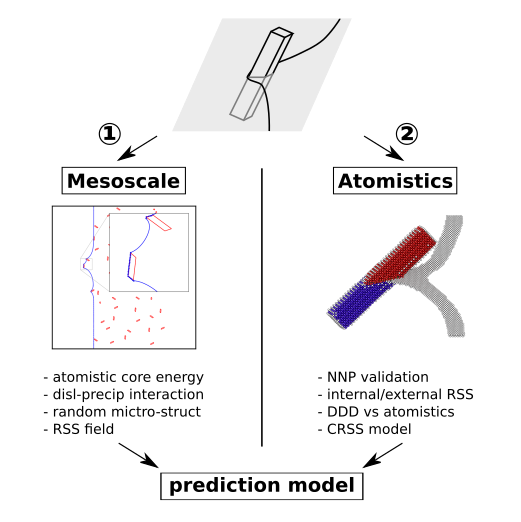
The key to the precipitation strengthening is dislocation-precipitate interaction mechanism, i.e. how precipitates serve as obstacle to impede the movement of dislocation. The entire roadmap of my PhD research is sketched in the following figure.
Dislocation Core Energy
One of the critical quantities in mesoscale simulation is Dislocation Core Energy, which influences the strength of dislocation when bumping into an obstacle. For that, I used a flat cylinder model to obtain the Dislocation Core Energy for various character angles.
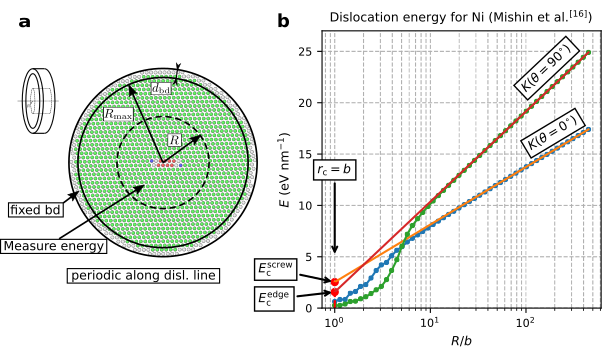
I then implemented this atomistic information in a widely used discrete dislocation dynamics code (ParaDiS). The atomistically informed DDD simulations match atomistic results across multiple benchmark cases.
Y. Hu et al. 2020 MSMSE
Mesoscale Study
The incorporation of atomistic core energy made me ready to investigate more complex dislocation-precipitate interaction. First, I carried out an extensive Mesoscale Study, since it is more efficient than atomistic simulations, and the behavior of dislocation is more tractable. The focus was peak-aged Al-Mg-Si alloys, where textbook understanding suggests that looping (Orowan) and shearing mechanisms can yield similar critical resolved shear stress (CRSS). So I would like to see if the simulation with Orowan mechanism can predict the yield strength of the material.
For this purpose, I implemented the Orowan mechanism in discrete dislocation dynamics, generated representative pseudo-random alloy microstructures, and calculated the corresponding misfit stress fields. Extensive DDD simulations were performed on different glide planes in experimentally realistic microstructures. Key factors—including precipitate volume fraction, matrix misfit stress, cross-sectional area, system size, microstructure, and dislocation core energy—were studied carefully and systematically.
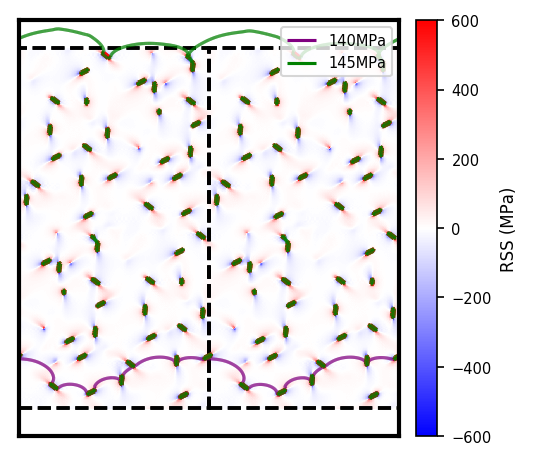
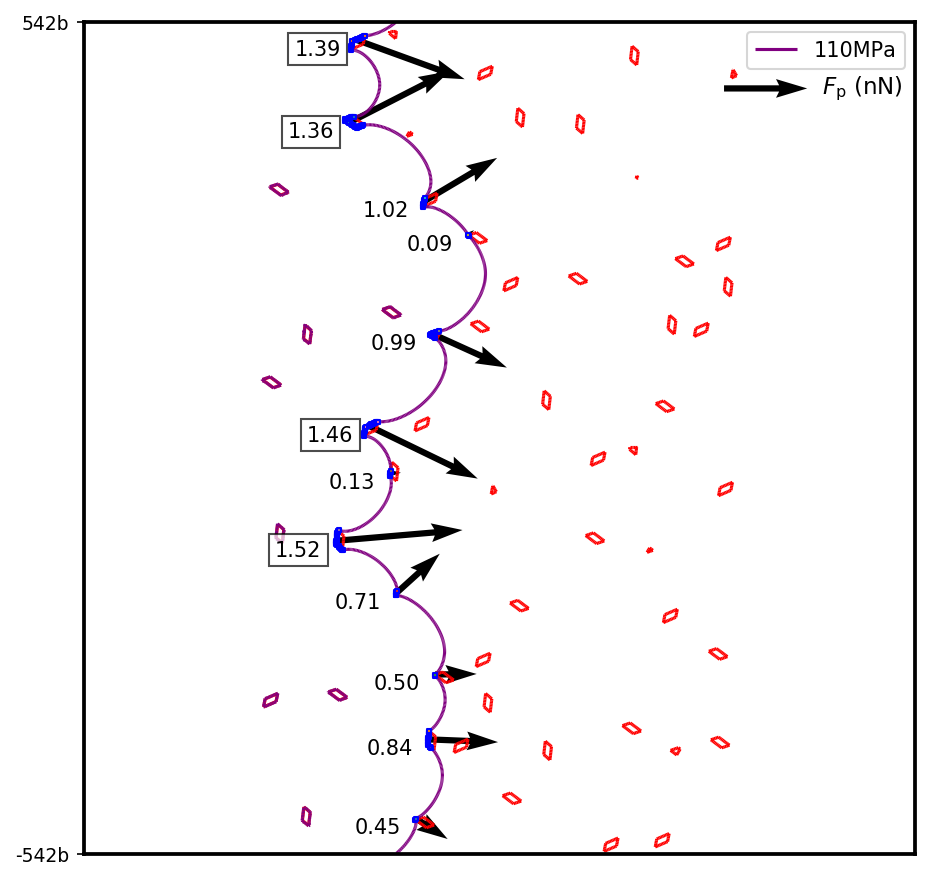
However, even with the core energy at finite temperature, we had an overestimate of material yield strength. Then I began to think about the cause of overestimate. A detailed force analysis on individual precipitates implied that multiple precipitates were supposed to be sheared before looped. And a simple shear calculation provides a better agreement with the realistic yield strength.
Y. Hu and W. A. Curtin. 2021 JMPS
Atomistic Study
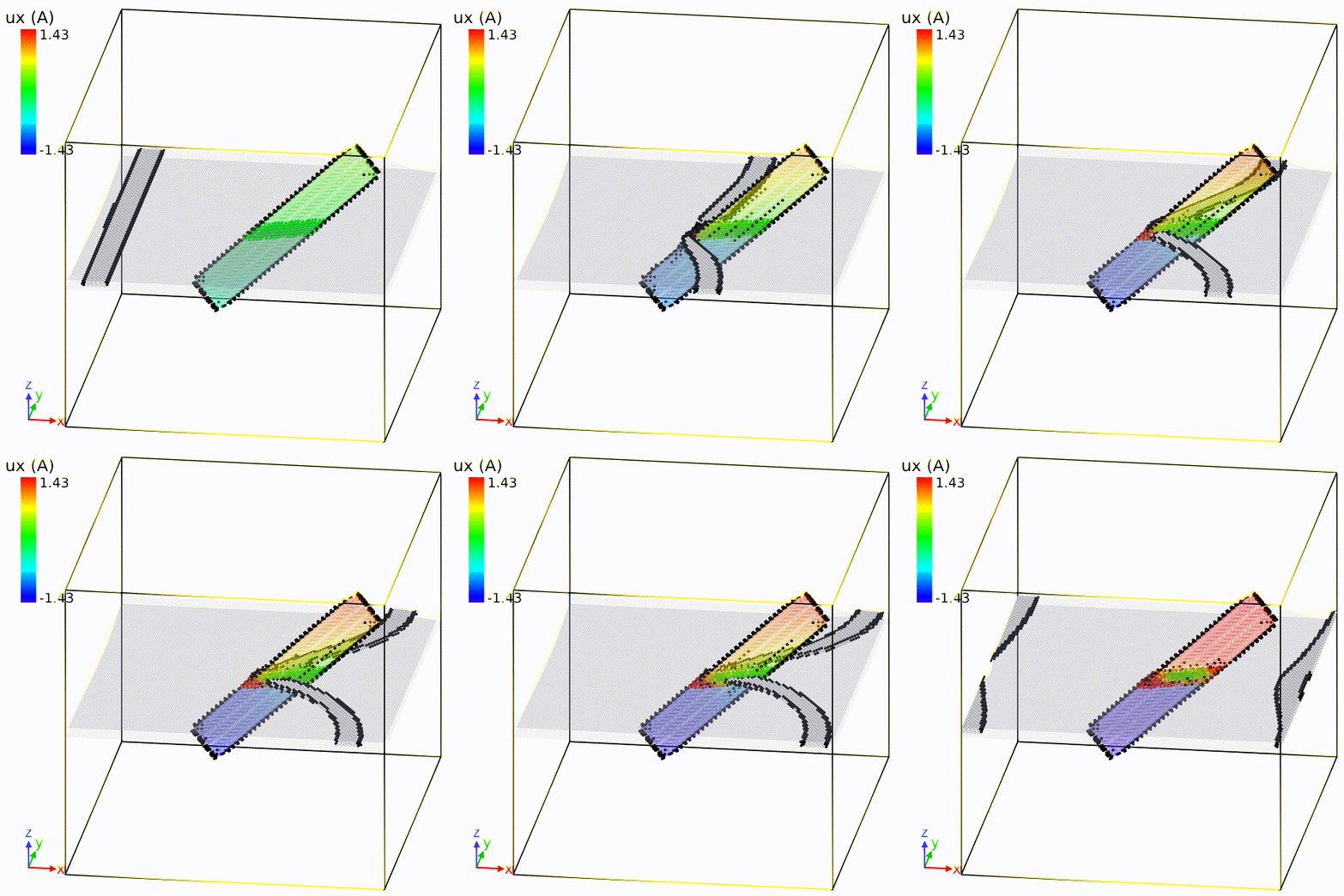
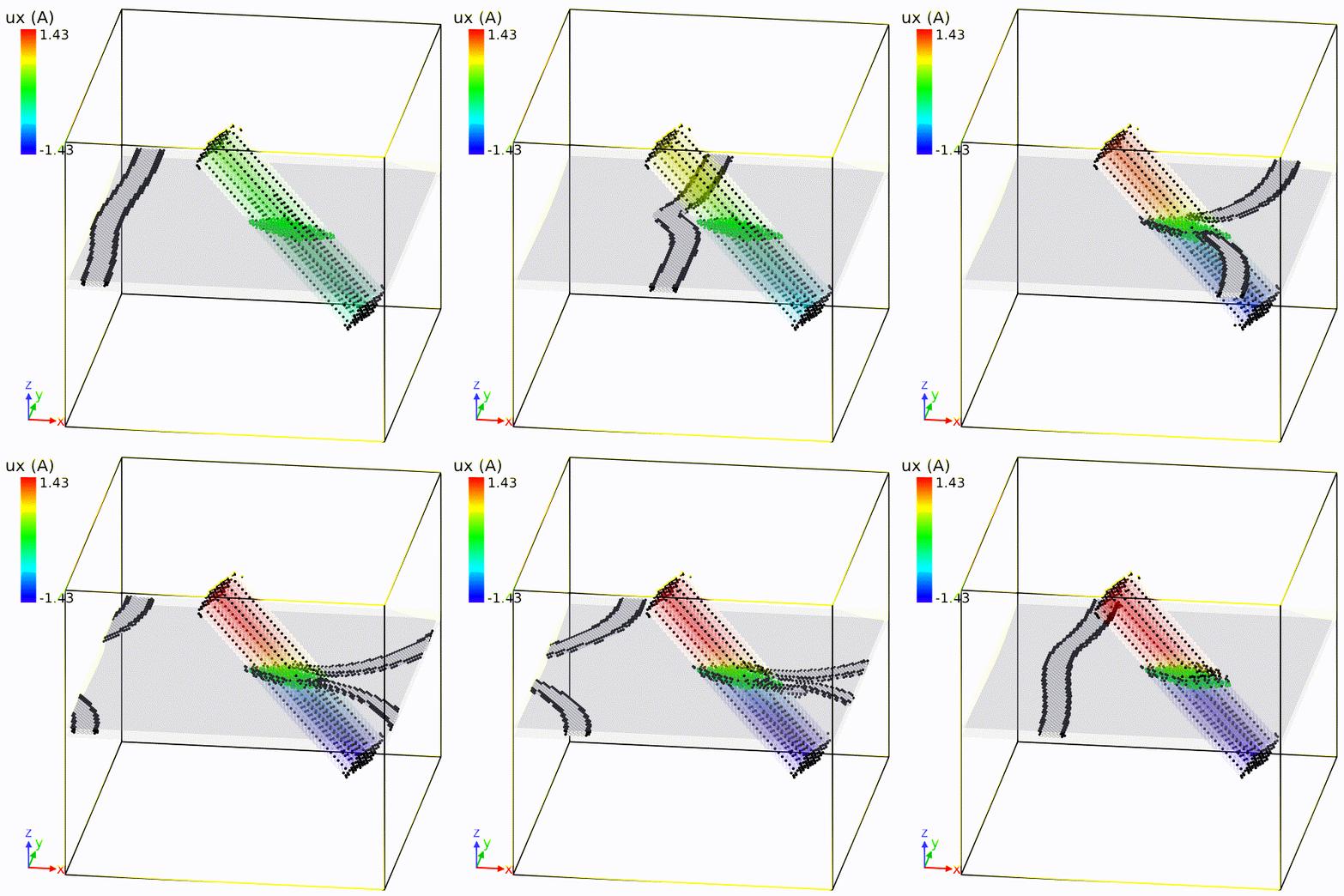
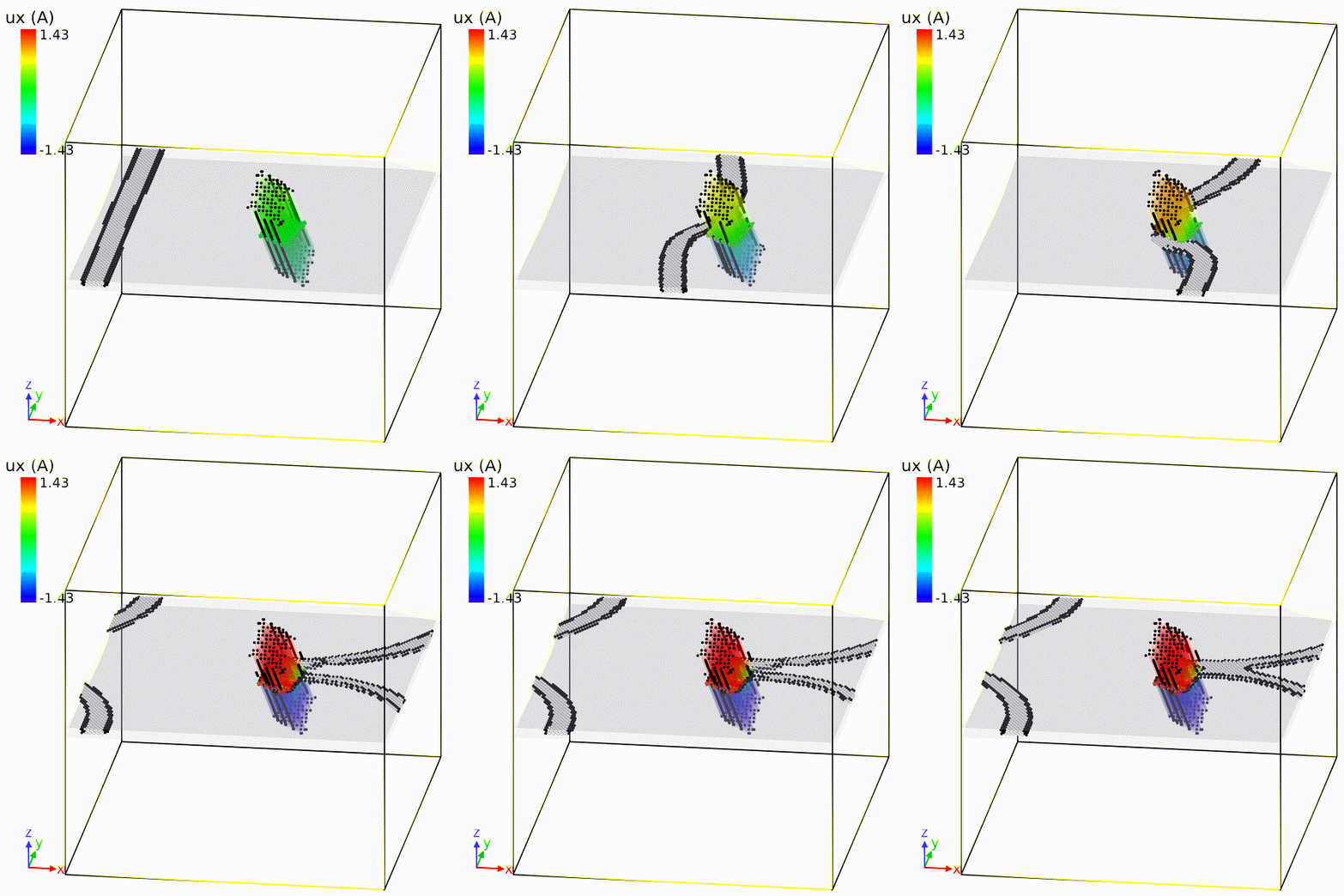
After the careful Mesoscale Study, I hoped to find out what really happens at atomistic scale. Does the precipitate really get sheared? A state-of-the-art neural-network potential helped answer this question. After extensive validation, we confirmed that the NNP was reliable for realistic mechanics problems. Systematic dislocation-precipitate interaction simulations were carried out. They showed that dislocation can either shear or loop the precipitate, depending on precipitate orientation and precipitate internal misfit stress.
Efficient DDD with Atomistic Accuracy
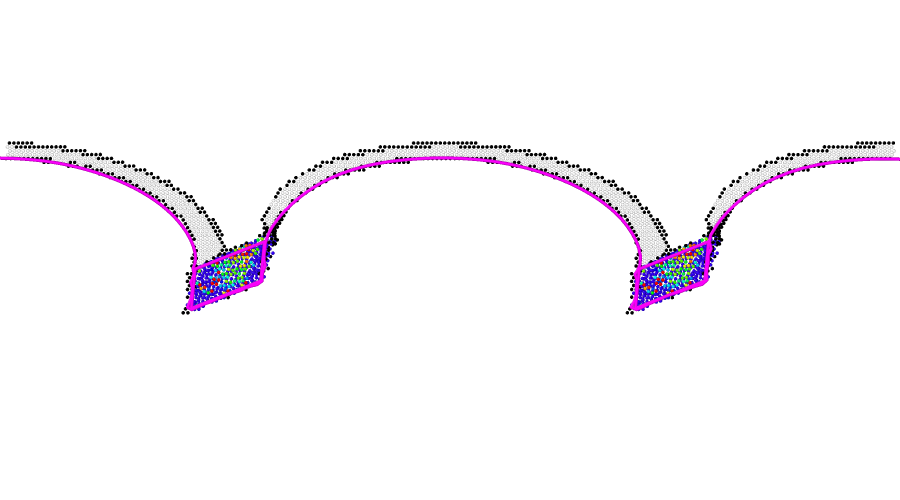
One key achievement of my research was giving DDD simulations near-atomistic accuracy by incorporating critical atomistic features (core energy, interaction behavior, and misfit stress). With lower level critical atomistic information, the DDD dislocation configuration matches quite well with the atomistic one (screw dislocation in the figure). Furthermore, the simulated CRSS is close to the expensive atomistic result. This shows that DDD, when enriched with critical atomistic quantities, can be trusted for predictive studies and can reduce the need for expensive atomistic simulations. This comparison between atomistic simulation and DDD laid the foundation for developing a strength-prediction model.
Prediction Model
Combining the knowledge obtained from mesoscale and Atomistic Study, we came up with a strategy for CRSS calculation. For looping mechanism, CRSS is calculated by the efficient atomistic-accurate DDD simulation, while for shearing mechanism, we have a validated Prediction Model. The lesser of two is the controlling mechanism. The prediction involves material properties (from ab-initio calculations) as well as geometry quantities, which can be optimized so that a maximal CRSS is attained.
For a realistic material, one needs to take into account many other factors, like the random arrangement of precipitate in a real system. I did a careful DDD study to demonstrate that a random factor can characterize this effect. A simplified prediction procedure is presented in the following figure.